Scroll down for english


This blog is bilingual. Scroll down for English.

Si quieres leer más sobre nuestras campañas anteriores, puedes hacerlo aquí


lunes, 5 de junio de 2017

Troubled waters


Another week gone! Time is running out but we are very focused on the day to day. Yesterday we took 6 hauls that gave enough to do. Here we always talk about the target species, but yesterday a total of 112 species of fish where collected, plus the invertebrates. And the catch per species ranged from 1g to 1t. The “cloud range” was less variable, from thick fog to completely overcast. But at least the fog vanished in the evening and when the sun went below the clouds there was a very beautiful sunset that Jose Luis photographed.


Atardecer en el Gran Banco por Jose Luis del Río

 
Teo's team at full throttle: Jose Luis V, Jose, José and David in the background, Fergus, Vanessa C and Rubén.

Today is way windier than yesterday, but the salts in the bridge know their trade and we are working normally. The weather may worsen tomorrow but we hope we will be able to work. So far today we have been between 40 and 60 m, and the hauls have been quite unequal in terms of catch, but always dominated by yellowtail flounder. Now we are looking for deeper bottom for the next haul. Meanwhile Nair carries on, with the CTDs and typing data. The CTD casts take their time, because they are not just about throwing the data logger overboard. Nair has to start it before each haul, record cast number and coordinates, download the data when the CTD comes back on board (which requires drying the plugs very well), check that the data logger worked properly, and at night it is necessary to clean the tubes through which the water circulates. I would not be surprised if she wraps it in a blanket before she goes to sleep. But the fact is that the CTD is working better than ever.

Nair does not waste a minute.


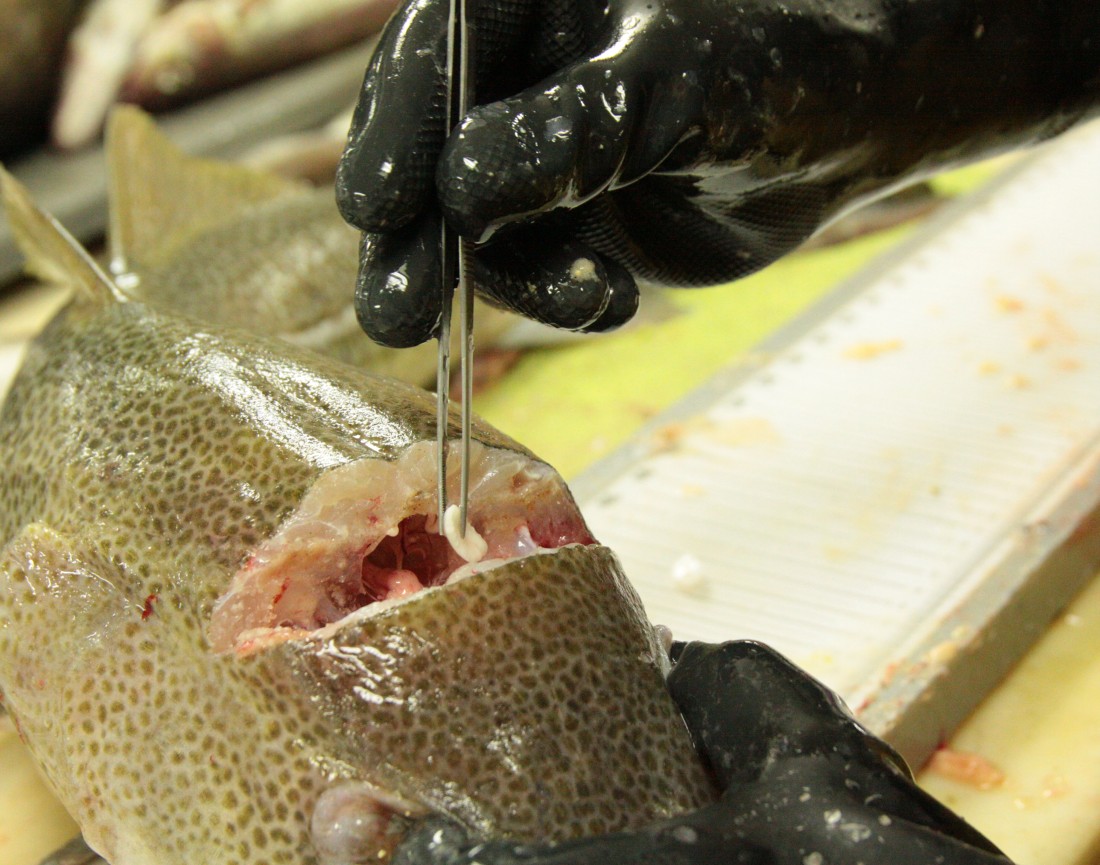
 But let’s talk fish. In the deepest haul we took yesterday we caught these tiny spiny lumpfish, barely 5 cm in length. They are called Eumicropterus spinosus and they are fairly common in the North Atlantic, but I have seen in an article by Casey and Myers (1998) that they are best caught at night. I opened one of them and it turned out to be a spawning female, and the eggs, orange coloured, had a diameter about 3 mm. Quite big for a tiny fish. Like in other lumpfish, the pelvic fins are modified like a disc with which they adhere to the bottom. These fish are passive to the point of being caught by divers, so the Norwegians Berge and Nahrgang (2013) were very surprised when they found in their stomachs plenty of amphipods called Themisto libellula, which move fast and are pelagic – they do not live on the seabottom. Berge and Nahrgang carried out further sampling to verify if the discovery had been just chance, but no, those amphipods seem to be the favorite course of spiny lumpfish. It is known that the zooplankton (of which the amphipods are part) undertakes daily vertical migrations: they go to the surface at night to feed and during the day they hide in deeper layers. What Berge and Nahrgang proposed is that perhaps many of the zooplankton species actually make it all the way to the seabed, rather than simply descending into layers where light is scarce. In other words, the spiny lumpfish have their food home delivered.


"Will he EVER shut up? Where is lunch?"

domingo, 4 de junio de 2017

Feliz fin de semana


Ya estamos apurando las últimas horas del fin de semana, que está siendo productivo en el sentido de que seguimos trabajando sin incidentes y de acuerdo al plan previsto, porque de pescado seguimos igual -salvo en lo que respecta a la gallineta, que está en alza respecto al año pasado y el fletán que se está dejando ver un poquito más.

Ayer hubo un rato por la tarde en el que pasamos de mar en calma, 3-4 nudos de viento y niebla cerrada a vientos de 30 nudos que hicieron la niebla jirones y dejaron el mar que parecía que hervía. Fue muy rápido, era la cola de una borrasca que pasó por el sur, pero se hizo sentir. No tuvimos que dejar de trabajar y acabamos el día con siete lances, uno de los cuales con el dudoso título de ser el lance más pobre de la historia de esta campaña, y acabamos dos estratos.

No es la foto del otro día: son los de máquinas trabajando en domingo.


Mañana haremos cuentas otra vez, porque hoy hemos completado otros seis estratos, y van 25. De los 16 restantes tenemos 5 a medias, así que vamos bien pero sin mucho margen para sobresaltos. Casi todos los estratos grandes están ya cubiertos, así que salvo para el fletán, que buena parte se pesca en la parte más septentrional de nuestra área de estudio, con las cifras de mañana tendremos una idea de cómo vamos a acabar.

El equipo de Jose Luis triando un lance de gallineta: Antonio, Vanessa, Lucía, Jorge, Cristina y Jose Luis.

Extrayendo otolitos de bacalao


Entre ayer y hoy la gallineta y los bacalaos son los que han dado más trabajo. La gallineta por abundante, y el bacalao por la cantidad de otolitos que había que extraer. La gallineta -como el bacalao- se pesca en varios caladeros en el Atlántico Norte. La del Mar de Irminger se pesca con aparejo pelágico (que no toca el fondo). Ésa fue una pesquería muy importante. No como la del bacalao, faltaría más, pero sí que llegó a concentrar una flota internacional de decenas de barcos. Con el tiempo se observó que cambiaba la distribución de la pesquería, no sólo geográficamente si no también en profundidad. Se investigaron estas poblaciones y se llegó a la conclusión de que había que cambiar el modelo de gestión y en vez de tratar todas las gallinetas como un único recurso era necesario investigarlas y gestionarlas como dos recursos (o unidades de gestión), uno somero a menos de 500m de profundidad, y otro profundo (a más de 500m).

Se constató además que la unidad somera estaba en bastante mal estado, y se aconsejó que no se pescase. La unidad de aguas profundas también presentaba una situación preocupante, y se decidió establecer una cuota que se iría disminuyendo con el paso de los años, hasta cerrar también esta pesquería. Pero no todos los países están de acuerdo. Hay una campaña internacional que se lleva a cabo bienalmente y cada año los resultados sugieren que las gallinetas del Mar de Irminger escasean cada vez más, así que me alegro de ver gallinetas en este rincón.

 
Las tapas del Vizconde

Mirad qué espectáculo

Los héroes


Hablando de gallinetas -que están muy ricas- no me queda más remedio que pasar a la cocina. Hoy es domingo y los domingos la cocina del Vizconde riza el rizo. Lo siento por el resto de la Humanidad que no está a bordo, pero allá van unas fotos de muestra. En las mesas además teníamos pulpo, queso y fuet, y de plato principal un arroz riquísimo. Y hemos cenado pez espada con patatas, ensaladilla rusa, pasta con jamón, pollo asado y algo me estoy dejando en el tintero… Es un conflicto tener que seleccionar. Y encima tenemos a nuestro camarero Manuel animando por si alguien está pensando en resistirse “¡Venga,muchachos, coman un poquito más que queda comida de sobra!”  Madres, no sufrais. Gimnasios, hacednos sitio. Mucho.   

La gestión de la gallineta es un rompecabezas.


Happy weekend


We are already in the last hours of the weekend, which is being productive in the sense that we continue working without incidents and according to plan, because with regard to fish there are not big changes. Except when it comes to redfish, which is on the rise compared to last year, and Greenland halibut which seems to be a bit more abundant. 


No, it is not the same photo of the other day. It's the engine room guys working on Sunday.


Yesterday afternoon we went in less than an hour from calm seas, 3-4 knots of wind and thick fog to 30 knots winds that shredded the fog and made the sea look like it was about to boil. It was the tail of a storm that passed through to the south of our location, it came and went very fast, shook us a little and that was it. We did not have to stop working and finished the day with seven hauls, one of them with the dubious title of being the poorest in the history of this survey. We also finished two strata. Tomorrow we will check our catches again, because today we have completed a further six strata, making a total of 25. Of the remaining 16 we have got some hauls in 5 of them, so we are doing well but without much room for delays. We have sampled already most of the largest strata, so except for halibut, which is usually mainly fished in the northernmost part of our study area, tomorrow we will have an idea of ​​how this survey will end. 


Jose Luis' team sorting a redfish haul. Antonio, Vanessa, Lucía, Jorge, Cristina and Jose Luis

Extracting cod otoliths


This weekend, redfish and cod have been responsable for keeping everybody very busy. Redfish because it dominated catches, cod because of the large amount of otoliths that had to be extracted. Redfish - like cod - are fished on several fishing grounds in the North Atlantic. The Irminger Sea redfish is caught with pelagic rigging (which does not touch the bottom). That used to be an important fishery. Not like Newfoundland cod, far from it, but it concentrated an international fleet of tens and tens of factory trawlers. With time it was observed that the distribution of the fishery changed, not only geographically but also in depth. The redfish populations in the Irminger Sea were investigated and it was concluded that the management model had to be changed and instead of treating all the redfish as a single resource it was necessary to investigate and manage them as two resources (or management units), a shallow one found at a máximum depth of 500 m, and a deep unit found at greater depths. It was also concluded that the shallow unit was in rather poor condition, and it was advisable to stop fishing it. The deep water unit also presented a worrying prospect, and it was decided to establish a quota that would diminish over the years,to see if the situation improved. However, not all countries accepted these measures. There is an international survey that takes place biennially and every year the results suggest that ​​Irminger Sea redfish are increasingly scarce, so I am glad to see redfish in this other region of the North Atlantic. 

Apetizers on board

Look at these beauties

The heroes: Héctor, Santomé, Suso and Manuel


Speaking of redfish, which are delicious, I have no choice but stop at the kitchen. Today is Sunday and on Sundays the Vizconde’s kitchen goes beyond the beyonds. I am truly sorry for the rest of Humanity that is not on board, but I must show some food photos. On the tables we also had octopus Galician style, cheese and sausages, and as main dish a delicious rice with meat and seafood. For dinner we had swordfish with potatoes, salad, pasta with ham, roast chicken and something else I cannot remember... It's a conflict having to choose among all this. And then we have our waiter Manuel encouraging us in case someone is thinking of resisting "Come on, guys, eat a little more! Enough food left!" Mothers, do not worry about us. Gyms, make room for us. A lot of it.

Redfish management is a puzzle.